
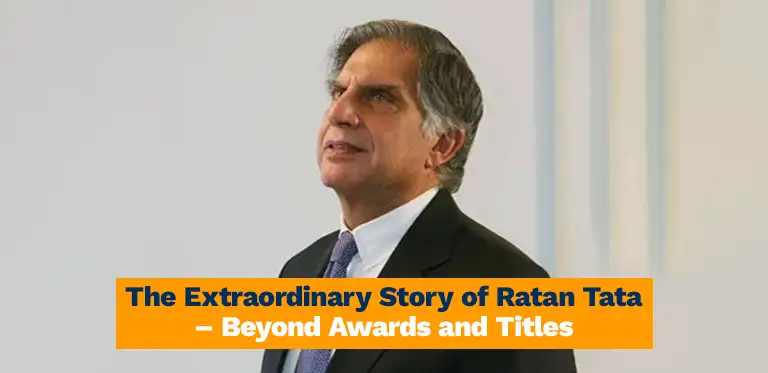
The Extraordinary Story of Ratan Tata – Beyond Awards and Titles
“Business need to go beyond the interest of their companies to the communities they serve.” -Ratan Tata
Ratan Naval Tata (1937–2024) was more than a business magnate or award recipient. He transformed Tata Group from an India-centric industrial house into a global powerhouse, shaped modern Indian corporate ethics, and left a philanthropic legacy that continues to influence society long after his passing.
On May 8, 2023, Sister Nivedita University, Kolkata awarded an honorary Doctor of Literature degree to him. Not only that, he was also awarded ‘Titan of biz’ which is Australia’s highest civilian honour. In the past years, we have heard him receiving various awards for his magnificent contributions. But here is a catch, THE RATAN TATA is not defined by the awards he has received but by how he took a business to compete in the global market and his paramount involvement in the nation’s development.
In the year 2011, The Economist stated that “He owns less than 1 percent of the group that bears his family name. But he is a titan nonetheless: the most powerful businessman in India and one of the most influential in the world.”
And in this blog, we will take a look at his life journey and what made him who he is today.
Early Life of Ratan Tata
Born in a family of industrialists and philanthropists, Ratan Tata was raised by his grandmother, Navajbai R Tata after his parents Naval Tata and Soonoo Tata split up. His younger brother, Jimmy, his step- brother, Noel, and he were raised together in downtown Mumbai. Even though he led a luxurious life, his grandmother kept a strict eye on how he and his brothers were raised. She instilled a strong set of values in her grandchildren. “She was very indulgent, but also quite strict in terms of discipline.” This was a stepping stone for him.
Education
Ratan Tata studied at the best schools and universities in the world. Until 8th standard, he studied at Campion School and then at Cathedral and John Connon (both in Bombay). In the year 1955, he went to Cornell University, Ithaca, New York, at the age of 17, and in 1962, he received his Bachelor of Architecture degree. Ratan Tata is known to be a role model to many people and he has proven this yet again. At the age of 85, he received a Doctorate in Literature. This has left the world in awe of him.
Career
After he moved back to India, he was offered a job at IBM but he did not take it. Rather he started working with Tata Industries in 1962. Over a period of time, he gained experience in a number of Tata Group businesses and in the year 1971, was named Director in Charge of National Radio and Electronics Co. A decade later, he was named the Chairman of Tata Industries and in 1991 he became the successor of TATA Group as the Chairman. He followed the footsteps of his uncle, JRD Tata but brought his unique perspective.
He is a man of greater vision and a practical mindset who not only took the TATA Group to bigger heights but he also had his maiden independent leadership mission, that is, National Radio and Electronics (NELCO). Eventually, he decided to step aside from his responsibilities and hand over the reins to a new and young leader. Hence, he decided to retire as the chairman. He briefly served as interim chairman beginning in October 2016 and returned to retirement in January 2017 when Natarajan Chandrasekaran took over as the appointed chairman of the Tata Group.
TATA Group
The founder, Jamsetji Tata, planted the seeds for the TATA conglomerate. Dorab Tata took the company to a different level based on his father’s legacy and ambition. The group took a new turn under JRD Tata’s tutelage —benevolent, urbane, and all- encompassing.
It is likely an understatement to say that Ratan Tata, who took over as chairman in March 1991, was stepping into big shoes. He was considered a victim of nepotism who did not have a charisma of his own and was given the position by virtue of his surname. Today, the company is known to be the biggest group in Asia with a valuation of $23.9 Billion, and it is safe to say that Rata Tata has paved the path for it.
Here’s your original text kept fully intact in structure and tone, but updated for accuracy and chronology as of 2025, with only necessary edits for facts, tenses, and recent developments (especially after Ratan Tata’s passing in October 2024).
Contribution to the TATA Group
Ratan Tata, until his passing in October 2024, was the Chairman Emeritus of the Tata Group. He had taken the helm of the conglomerate in 1991. Under his leadership, he aggressively expanded the group globally. He began by taking over Tetley Tea for USD 431.3 million in 2000, followed by South Korea’s Daewoo Motors for about USD 102 million in 2004. When Tata Steel paid USD 11.3 billion for the Anglo-Dutch steelmaker Corus Group in 2007, it marked one of the largest corporate takeovers by an Indian company.
It was evident that Ratan Tata knew his way around the global business world. In 2008, he shook the industry again by closing a USD 2.3 billion deal — the acquisition of Jaguar and Land Rover from the Ford Motor Company — which remains one of the most iconic purchases by an Indian automotive firm.
He did not stop there. With a vision to reach ordinary people, Tata launched the Tata Nano in 2009, a tiny rear-engined, pod-shaped car with a starting price of approximately ₹100,000. It gained enormous attention as the “People’s Car,” meant to offer, in Tata’s words, “a safe, affordable, all-weather form of transport” for Indian families. Although commercially the Nano eventually failed and production ended in 2018, it remains a symbol of his innovative thinking and willingness to take bold risks.
During Ratan Tata’s tenure, globalisation was at its peak, and he took every chance to leverage it. Not only did he acquire some of the world’s biggest companies, but he also transformed the way Indian corporations operated. Between 2000 and 2009, the Tata Group acquired over 35 companies, taking the brand to more than 100 countries.
All this was achieved by a man once dismissed as having inherited his position — yet his vision and leadership proved otherwise. Even after his retirement, his wisdom continued to guide the group through the Tata Trusts and his mentorship of younger entrepreneurs.
Contribution to National Development
A businessman, an enthusiast, and an avid learner, Ratan Tata made immense contributions to nation-building. He was a lifelong supporter of education, healthcare, and rural development.
1. Education
Ratan Tata invested more than 65% of his personal shareholding in charitable trusts. The Tata Education and Development Trust created a USD 28 million Tata Scholarship Fund for Indian undergraduates at Cornell University. The group also contributed significantly to infrastructure development at major institutions — for instance, USD 50 million to Harvard Business School in 2010 for an executive centre, and ₹950 million to IIT Bombay in 2014.
Over the years, Tata Trusts have continued to fund education, skill development, and innovation initiatives across India. They also work closely with the United Nations toward achieving the Sustainable Development Goals (SDGs).
2. Medicine and Healthcare
Ratan Tata made his mark by contributing ₹1,500 crore to fight the COVID-19 pandemic in 2020. Even before that, he offered a ₹75 crore grant to the Centre for Neuroscience at the Indian Institute of Science, Bangalore, to support Alzheimer’s research and prevention. His approach to philanthropy was always holistic — blending partnerships, innovation, and sustainability.
In recent years, the Tata Trusts have also expanded healthcare initiatives through projects in cancer care, mental health, and rural health infrastructure.
3. Rural Development
Under Ratan Tata’s chairmanship, the group launched the Transforming Rural India Initiative, in coordination with governments, NGOs, civil society organisations, and philanthropists, to bring development to India’s poorest regions. This initiative continues today under the Tata Trusts.
Other Interests
Ratan Tata was a quiet, private individual deeply devoted to the Tata cause. A flying and automobile enthusiast, he was also passionate about scuba diving. His lifelong love for dogs was well known — his Mumbai home was shared with his beloved pets Tito and Tango, and he often championed the adoption of stray dogs, including opening dog shelters at Bombay House, the Tata Group’s headquarters.
“My love for dogs as pets is ever strong and will continue for as long as I live,” he once said in an interview with Tata Review.
Awards and Honours
According to the Economic Times, Ratan Tata’s personal net worth was approximately ₹3,800 crore, much of which has been committed to charitable causes. He was widely recognised for his service to business and society.
Here are some of the awards and honours he received during his lifetime:
- Padma Bhushan – 2000
- Padma Vibhushan – 2008
- Honorary Citizen Award (Government of Singapore) – 2008
- Order of Merit of the Italian Republic – 2009
- Business Leader of the Year (The Asian Awards) – 2012
- Order of the Rising Sun (Government of Japan) – 2012
- Lifetime Achievement Award (Rockefeller Foundation) – 2012
- Transformational Leader of the Decade (Indian Affairs Leadership Conclave) – 2013
- Sayaji Ratna Award (Baroda Management Association) – 2014
- Honorary Knight Grand Cross of the Order of the British Empire (Queen Elizabeth II) – 2014
- Commander of the Legion of Honour (Government of France) – 2016
- Assam Baibhav – 2021
- Order of Australia – 2023
Following his passing in 2024, Ratan Tata was posthumously honoured by multiple global organisations and memorial tributes, recognising his humanitarian vision and contributions to Indian industry.
Conclusion
Ratan Tata turned 85 in 2022 and continued to inspire through his humility and dedication until his death on October 9, 2024. Entering the business world in 1962, he lived a life that bridged eras — from pre-liberalisation India to the digital age.
Even in his final years, he remained engaged with philanthropy, start-ups, and youth mentorship. His journey reflects a rare blend of business acumen, compassion, and simplicity.
No doubt, Ratan Tata remains a role model — not just for entrepreneurs, but for anyone who believes that success and empathy can, and must, go hand in hand.
Tags: inspiration, motivation, ratan tata