

New National Education Policy 2023: The Complete Guide
India was known as “Vishwa Guru” a long time ago. The country had some of the greatest minds and concepts to give to the world. The primary focus of education in ancient India was to help students develop holistically with a focus on real-life education, preparation for life along with complete realisation and liberation of the self. Moreover, some of the world’s schools and institutions are inspired by India’s old schooling traditions such as the Gurukuls, and today we know them as boarding schools.
India has always been a major contributor in the gamut of fields including yoga, mathematics, chess, metallurgy, medical science and surgery, astronomy, civil engineering, architecture, shipbuilding and navigation, fine arts, and others. High standards of transdisciplinary teaching and research were set by world-class institutions in ancient India, such as Takshashila, Nalanda, Vikramshila, and Vallabhi, which also welcomed researchers and students from all backgrounds and nations. And who doesn’t know the prominent scholars of India? Chanakya, Maitreyi, Gautama, Patanjali, Chakrapani Datta, Madhava, Panini, Aryabhata, and many others who made a significant impact on the world as we know it today.
If India has so much to offer to the world then why are most of the students moving abroad for studies and to settle? Why is 6 lakh in India too much amount but in other countries, it’s the individuals’ minimum wage? Where did India fall back? In this article, we will gain a deeper understanding of India’s education system and what the future holds for it.
History of the Indian Education System
In India, the concept of education policies has been there since the time of the Britishers. Philosophers and scholars, today, study India’s education policies in two parts, that is, pre-independence and post-independence, and are also further divided.
Until 1000 AD, there were not many literary sources to define the education system. The prominent sources before this time that gave us a brief about the education system of that time were the Rigveda, the Aranyakas, the Upanishads, the Epics, and the Puranas. Aryans were the first to introduce a formal education policy in India. After the development of kingdoms, during the Vedic period, powerful kings and leaders focused on higher education. During this time, enough emphasis was laid on universities such as Nalanda and Taxila. Eventually, different communities including Buddhism, Brahmanism, and Islam stood at an impasse related to how education will be influenced according to their religion and beliefs.
During the British period, modern and formal education came into being. This was the first revolutionary incident in the history of education in India. Although, there is no denying that the Britishers focused on spreading Christianity among the locals, but they also gave a new turn by making education more accessible to all the people. It was not restricted to people of higher statutes. They encouraged educational activity by establishing schools and grants-in-aid.
Hence, in the year 1715, St. Mary’s School was established in Madras, followed by the establishment of two more charity schools in 1717 by the Danish missionaries. In 1718 a charity school in Bombay and another in 1731 in Calcutta were opened. In 1781, Sir Warren Hastings, the first Governor-General of India, established the Calcutta Madrasa which was focused on Arabic and Persian studies. Additionally, in 1791 he also founded the Benares Sanskrit College to promote classical studies in Sanskrit. Additionally, Indian reformers such as Raja Ram Mohan Roy also played a significant role during this time.
Now, let’s discuss education in the post-independence era. It was evident that new India needed new reforms that cater to the needs of locals. Hence, previous reforms were restructured. According to new reforms, university education and senior secondary education should be separate. There were many such decisions that were to be taken and the goal set for the country’s educational policy was to create a system of universal elementary education by 1960.
After independence, India adopted the Constitution in 1950, according to that, education became the responsibility of both state and central governments. It was during this time that Education Commissions were also set up. The first Commission was the University Education Commission of 1948, followed by the Secondary Education Commission (1952). Next, was the Indian Education Commission introduced for the academic year 1964-66. And with that, the first National Education Policy was put into place in 1968.
After the 1968 policy, a new one was formulated in 1986 which was modified in 1992. After that, Manmohan Singh again modified the 1986 policy in 2005. After 34 years, India has adopted a new policy, that is, New Education Policy 2020. Previous policies have mostly dealt with concerns of access and equity but this policy addresses the unfinished business of the Policy of 1986. The Right of Children to Free and Compulsory Education Act of 2009, which established the legislative foundations for achieving universal basic education, was a significant step since the previous policy of 1986/92.
The Need for New Policy: National Education Policy 2023
As we have seen before previous education policies weighed too much on access and equity which is, no doubt, still the primary goal but there are other factors that should be taken into consideration, especially in the age of digitisation. The world is changing at a fast pace and to keep up with it, India had to create the perfect blend by leveraging its traditions & cultures and adopting new & modern ways.
The world has moved from a physical labour-based economy to a brain-based economy and the National Education Policy is a bridge between the both. Universities prefer students who have an interest in academics and extracurriculars; organisations prefer skills or degrees and that’s where the policy steps in.
Goal 4 of the 2030 Agenda for Sustainable Development aims to “ensure inclusive and equitable quality education and promote lifelong learning opportunities for all”. This can be achieved only when India transforms its entire education system to meet the goals of the agenda as well as compete in the global market.
There is a huge gap between what is the current process and what is desired. Implementing significant reforms that focus on the finest quality, and integrity in the system, and are enforced during early schooling days can truly bring the best outcome.
What is New National Education Policy 2023 (NEP 2023)
National Education Policy 2023 is the first education policy of the 21st century and aims to provide quality education to all irrespective of their socio-economic background. This Education Policy lays emphasis on technology, innovation, and educational research. It stresses the importance of critical thinking, creativity, and problem-solving skills, and encourages the use of diverse teaching methods and local resources.
Here are the parameters on which NEP 2023 is based:
-
Focus on holistic development of students by recognising, identifying, and fostering the unique capabilities of each student as well as sensitising parents as well as teachers.
-
Achieving foundational literacy and numeracy by all students by Grade 3.
-
Focuses on the flexibility of education.
-
No separation between arts and sciences, curricular and extracurricular activities, vocational and academic streams, etc.
-
Emphasis on conceptual learning over rote learning
-
Emphasis on critical thinking, decision-making, innovative learning, etc.
-
Focus on ethical and humane values.
-
Promoting multilingualism and the power of language in teaching and learning.
-
Focus on life skills such as negotiations, communication, etc.
-
Promoting the use of technology.
-
Focus on teachers’ training and mentorship programmes.
-
Special emphasis on reviewing the work given to the students.
-
The schools’ structure 10+2 will be changed to 5+3+3+4
-
Multiple entry and exit options in degree courses.
-
Discontinuation of MPhil Programmes.
-
Decreases the number of entrance exams.
-
Board exams will be held twice a year.
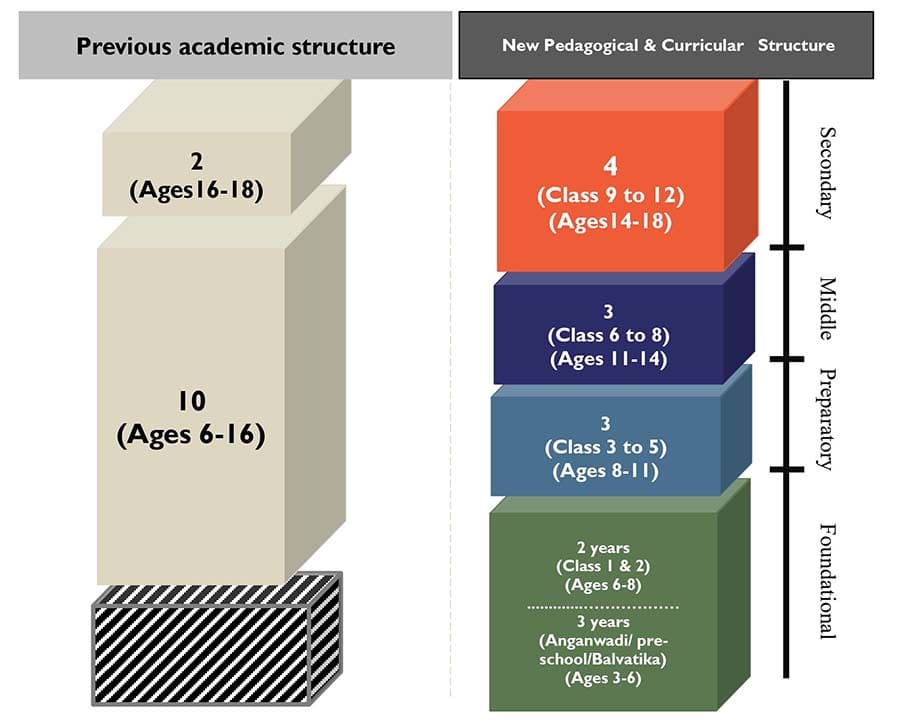
Source: education.gov.in
Is India Ready for NEP 2023?
Did you know that, according to a report by ASER, 50% of children in government schools cannot read, write or do basic arithmetic despite being in school for 4-5 years? And when you hear it, you begin to question if India is ready for technological adaptation, and internationalisation. According to the UNDP index, pre-pandemic data shows that India has the highest population of poor people with a total of 228.9 million. Do you think that these 228.9 million people are concerned about education or rather they earn the bare minimum to feed themselves and their families?
India, in the 21st century, is fixated on competing in the global world and is inviting international universities when the students don’t have the foundational knowledge. Additionally, India has only a budget of 2.9% of the GDP reserved for education. How can the government cover infrastructural development, reach out to remote areas, and invite foreign universities at this low budget? And can it depend on only foreign investment for the revolution that the New Education Policy talks about? The country is far from removing this disparity. That’s something to think about!
Conclusion
India has come a long way, indubitable, but what the government and leaders need to remember is that the law, policies, and schemes should not only be stringent on paper but also see the light of the day and make an impact if the country wants to fulfil it’s 2030 Agenda for Sustainable Development. What’s your take on NEP 2023? Tell us in the comments below.
Tags: national education policy, national education policy 2023, nep nep 2023, new education policy, new education policy 2023