

Financial Analysis – Synthetic Division in MBA Success.
Optimizing Financial Analysis with Synthetic Division: A Practical Approach for MBA Students
In the business world, understanding financial analysis is crucial for MBA students. Various financial challenges can be efficiently solved using advanced optimization techniques, from managing assets to handling risks and pricing options to calibrating models.
Among the various techniques, the synthetic division stands out as a game-changer. Various optimization problems are included in the MBA course such as linear, quadratic, integer, dynamic, and more. In a world where time is crucial, the synthetic division calculator saves time and improves accuracy, enabling students to solve complex polynomials and concentrate on deriving meaningful insights from the data.
This article explores how MBA students can use synthetic division to streamline complex calculations, making financial analysis more accessible and efficient.
Basics of Synthetic Division

This is a mathematical technique that lets you perform quick and precise division of polynomials. For MBA students, using an online tool serves as a shortcut that simplifies complex division, particularly when working with financial equations.
It means to divide the polynomial expression by a linear factor, mostly to determine the zeros of the polynomial. It requires the leading coefficient to be 1.
How Do I Divide Polynomials Using Synthetic Division?
To divide polynomials using synthetic division, follow the below-mentioned steps:
-
Write down the value of “k”
-
Determine the coefficients of the dividend and write them on the paper
-
Get the leading coefficient and write it down
-
Multiply “k” with the leading coefficient and write the result in the next column
-
Sum the terms of the second column
-
Now multiply “k” by the resultant value and write the result in the next column
-
Continuously repeat steps 5 and 6 for the remaining columns
-
Write the last column’s number as the remainder having a zero degree. The next number to the left has a degree of 1, the next has a degree of 2, and so on. Show the bottom number as the quotient
Example
Let’s simplify the division of 9x^3 + 4x + 8 by x + 3, providing a quick and efficient quotient for the given polynomial.
Solution:
9x^3 + 4x + 8 / X + 3
The coefficients of the numerator polynomial
9, 4, 8
Figure out the zeros of the denominator
X + 3 = 0
X = – 3.0
Note down in the form of synthetic division
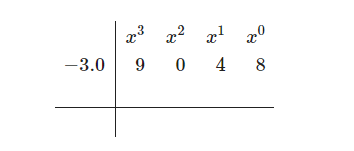
Get the leading coefficient and write it down
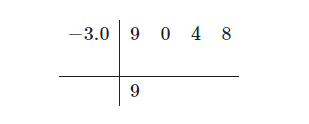
Multiply the obtained value by the zero of the denominator, and take the resultant value in the next column
9 * (-3.0) = – 27
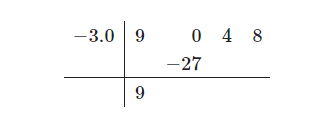
Now sum the column
0 + (-27) = – 27
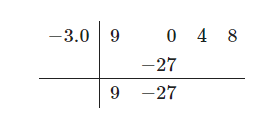
Repeat the previous steps
-27 * (-3.0) = 81
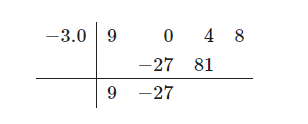
Add down the column
4 + (81) = 85
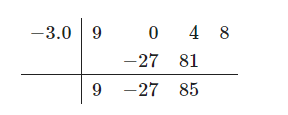
Repeat the previous step multiply the result by the zero of the denominator, and write the outcome in the next column
85 * (-3.0) = -255
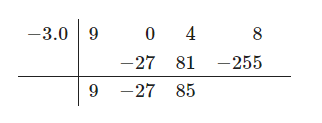
Add down the column
8 + (-255) = – 247
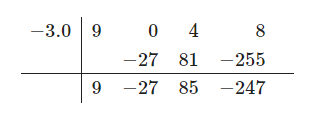
The value of the quotient is 9x^2 -27x +85, and the remainder is -247
Instead of dragging yourself into manual calculations, simplify the process by using the polynomial synthetic division calculator. Using the online tool guarantees a speedy and accurate computation.
Practical Application of Synthetic Division in MBA Finance Courses
The students of MBA need synthetic division to perform various tasks like evaluating investment returns and analyzing financial trends. The use of a synthetic division lets the students speed up the process and helps in making correct data-driven decisions. Meanwhile, it’s very useful in handling complex polynomial expressions in financial modeling, offering a reliable and smooth solution.
As technology transforms the business world, MBA programs must evolve to equip students with practical skills. Including tools like the synthetic division calculator in the curriculum helps to improve the learning experience, preparing students for real-world financial analysis, where efficiency and precision are vital aspects of success.
Moreover, synthetic division finds practical use when studying financial trends and forecasting. In MBA finance courses, students often have to deal with polynomial expressions representing complex financial models. The online calculator has become a reliable companion in navigating through these complexities, allowing students to focus on interpreting trends and patterns Instead of getting confused with manual calculations. This practical application ensures that MBA students can handle real-world financial scenarios efficiently and precisely.
Conclusion
In MBA education, it’s crucial to use innovative tools to keep yourself at the heights of success. The synthetic division calculator is a valuable tool that simplifies complex polynomial division and saves time so that the students can use this time in their studies and focus on data insights, for deepening their understanding of financial dynamics. As business evolves, incorporating these tools ensures MBA graduates are thoroughly equipped to tackle financial challenges with confidence and expertise.
Tags: calculator