

The Future of Distance Education: Trends to Watch
“The idea that one can earn a degree at the age of 22 and be set for a career has become as antiquated as the pocket watch.”
—Jeffrey R. Brown, Dean, Gies College of Business, University of Illinois
The AI revolution is changing the way we look at the world. Every day we see a number of innovations and technical breakthroughs that revolutionise our life. According to a report, more than 2,000 new AI tools have been released in the last 30 days. This changing technological landscape demands for a workforce that can quickly adapt to these emerging technical skill requirements.
Today, it is no longer enough to rely upon a college education to fulfil all the future needs of your professional journey. This calls for an alternative mode of learning which is agile and can cater to the upskilling and reskilling needs of working professionals. Distance education presents the perfect solution for these needs. Often referred to as the renaissance of modern education, distance education engages learning in various self-learning activities and helps them become self-sufficient individuals.
Why Distance Education?
Distance education fulfils all three major goals of education, that is, innovation, quality and employability. It helps learners actualise their potential with an advanced curriculum and industry-integrated learning. The biggest advantage of distance learning courses is that it makes education less structured, thus making room for multi-disciplinary learning. This helps make education more learner-centric as students can personalise their courses based on their needs and interests.
Future Trends to Watch Out for in the Domain of Distance Education
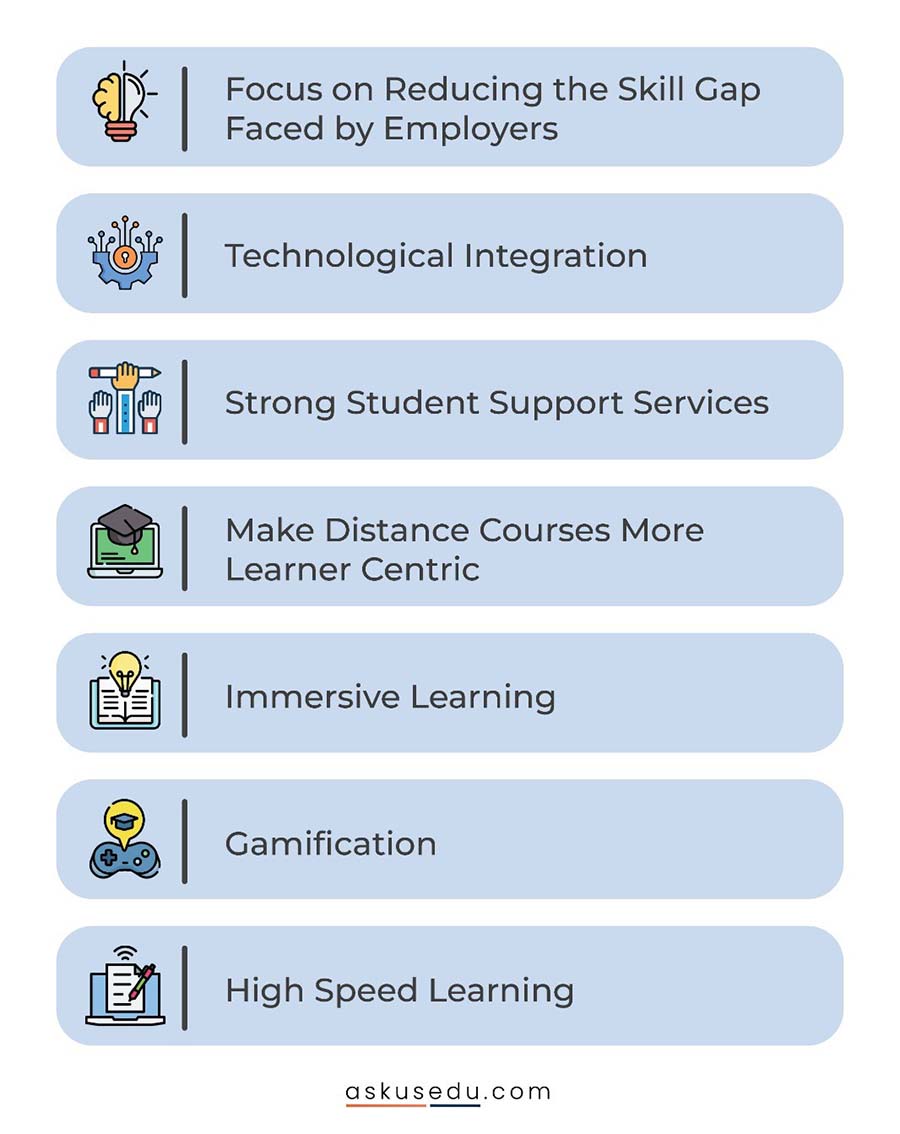
Universities are in a constant endeavour to make education more accessible, skill-based and lifelong for a larger chunk of students through the distance mode of education. Therefore, they keep looking for opportunities to enhance their existing models and integrate newer modalities. This year, many new transformations are expected in the domain of distance education. Let us quickly take a look at them.
1. Focus on Reducing the Skill Gap Faced by Employers
As already mentioned, the demands of the workplace are continuously changing. Learners are expected to be well-equipped for advancements that have not even occurred yet. Thus, universities need to come up with ways that can help learners become more flexible. They must be able to adapt to change quickly. Not just this, but the universities must also offer ways to learners wherein they can readily verify whether or not they have mastered various concepts and skills.
2. Technological Integration
Universities are integrating various newer technologies into their learning system so as to increase the impact of education. Most of the universities offer students enrolled in distance learning courses access to advanced learning management systems. For instance, Amity University has set-up a digital platform- AMIGO that takes care of all the academic needs of students. It provides them with various learning resources and offers them a real-world classroom experience.
3. Strong Student Support Services
There is a dire need for a strong support network for students enrolled in distance learning courses. Some universities provide online discussion forums, live doubt-clearing sessions and helpline numbers to make sure that the queries of students get addressed at the earliest. However, the need is to not depend on any one mode of communication. Look at IGNOU for instance. They are using multiple channels of communication such as audio-video teaching, radio phone to offer interactive counselling, radio-television and teleconferencing for doubt redressal and many digital learning initiatives such as Gyan Darshan, Gyan Vani & Virtual Campus initiative.
4. Make Distance Courses More Learner Centric
The Digital Age calls for newer career paths, covering multiple streams. Therefore, it is imperative in today’s world to continuously upskill and reskill yourself and instantly put those skills to use. Today, it is crucial for universities to reconfigure their suite of educational products in the distance mode according to the needs of the learners. The focus should be on promoting a more learner-centric approach and offering courses which can be customised as per the evolving needs of students.
5. Immersive Learning
Many universities are integrating virtual reality and augmented reality into their teaching systems so as to make education more engaging for students. These technologies make it easier for students to comprehend difficult concepts by providing them with a real-time practical experience of the same. They further help students understand the various applications of theoretical concepts and help them come up with innovative ideas. AR and VR are especially revolutionising the arena of distance learning by making up for the lack of practical learning experiences.
6. Gamification
More and more universities are adopting this innovative technique wherein they add certain interactive games to the module to increase the student’s engagement. This makes learning a more immersive and participative experience for both the learners as well as the instructors alike. Not just this but it also helps in enhancing the cognitive abilities of students and thus, makes them better decision-makers.
7. High-Speed Learning
A study conducted in 2014 claims that over 94% of the students who are enrolled in distance and online courses prefer shorter courses over long modules. This is primarily because of the fact that students believe that a lot of information is poured over in case of long-duration courses. This is where high-speed learning comes into the picture. Here, the course is divided into three short courses which can be pursued in quick succession. This helps students to absorb all the basic concepts before they move on to the more advanced principles and applications of these fundamentals.
Takeaway
There was a time when education was a luxury and was restricted to a small section of the society. However, times have changed and today, education is no longer a desire, rather it has become a necessity to survive in the world. Distance education has been addressing the educational needs of a large segment of people. Universities are on a constant lookout for ways in which they can enhance the learning experience of students who are enrolled in distance courses by integrating newer technologies and identifying areas for improvement.
Tags: Distance Education, distance education trends, future of distance education, technology in education