

Female Education and the Changing Global Landscape
“Educate your women first and leave them to themselves: then they will tell you what reforms are necessary for them.” -Swami Vivekananda.
Education is a fundamental right to which every individual should have access, regardless of gender. However, females have been marginalised and denied access to education for many years, leading to a gender gap. The good news is that the global landscape of female education is changing, and more and more girls are now attending school.
This article explores the changing global landscape of female education and its consequential impact.

What is Female Education?
Female education refers to providing educational opportunities and resources for girls and women. This includes ensuring that girls have access to schooling at all levels, from primary to tertiary education, and have the resources and support needed to succeed in their studies.
Historically, women have been denied equal access to education in many societies around the world, often due to cultural or societal beliefs that prioritise male education or restrict women’s rights and opportunities.
However, providing education to women has been recognised as a critical factor in promoting gender equality, reducing poverty, and improving the overall well-being of communities and societies.
As a result, many efforts are being made to encourage and support female education worldwide, including policy initiatives, targeted funding, and community education programmes.
Women Education: A Cornerstone of Women’s Empowerment
“Give me an educated mother, and I shall promise you the birth of a civilised, educated nation.” -Napoleon
Empowering women enables and develops their abilities and potential so that they can think and act freely, exercise their choices, and take control of their lives. This process aims to reduce discrimination and exploitation against women and uplift them in social, economic, and political spheres.
As a result, empowered women can play an equal role alongside men in society, leading to greater gender equality and a more just world.
The Malala Fund reports that over 130 million girls are not receiving an education globally. This lack of education often leads to early marriages, limited job opportunities, and dependence on husbands or families for financial support. Without access to education, women’s and their families’ futures are limited.
There is no denying that education is crucial to women’s empowerment as it provides greater access and opportunities in the workforce, resulting in higher income and less isolation at home. It also enables women to pursue their own goals and values, allowing them to live their dreams and contribute meaningfully to society.
Additionally, female education is immensely important for personal growth, societal development, and global progress. Educating females has a multitude of benefits, including economic growth, improved health outcomes, population control, and more equitable society.
Education equips females with knowledge and skills, enabling them to make informed decisions and become active contributors to their communities.
Furthermore, it promotes gender equality, empowers females, and helps break the cycle of poverty. Thus, educating females is crucial to achieving a more equitable and prosperous future for all.
To gain a deeper understanding of the profound impact that a classroom and a few books can have, let’s take a look at some compelling reasons why female education is crucial.
- Increased Literacy :
Out of the 163 million youth worldwide who cannot read or write, almost 63 per cent are female. Ensuring that all children receive an education would significantly improve literacy rates, thus advancing the development of underprivileged regions.
- Political Representation:
Around the world, women need to be more adequately represented when it comes to political involvement. The United Nations Women’s programmes focused on leadership and participation recommend that providing civic education, training, and empowerment opportunities would help to close this gap.
- Healthy Babies:
The United Nations Girls’ Education Initiative states that children whose mothers have received an education are twice as likely to survive beyond the age of five.
- Later Marriage:
The United Nations Population Fund suggests that in less developed countries, one out of every three girls is married off before turning 18. However, in regions where girls receive at least seven years of education, the age of marriage is delayed by four years on an average.
- Income Potential:
Education can also enhance a woman’s financial independence by expanding her earning potential. UNESCO (United Nations Educational, Scientific and Cultural Organisation) reports that even just one year of primary education can increase a girl’s future wages by up to 20 per cent.
- Economic Development:
Educating women is a vital factor in promoting economic development. It is the same as administering an effective medication to cure an illness and restore health. Women play a critical role in national development as they constitute more than half of the population in most countries. Therefore, failure to educate women leads to slow development and less productive society. Moreover, women work alongside their male counterparts to raise families.
- Eradicate Poverty:
Enabling women to enjoy equal opportunities to access education allows them to participate fully in business and other economic activities. For example, their entrepreneurial abilities, mathematics, and research skills equip them with the knowledge to venture into various ventures successfully.
Additionally, educated women have higher earning potential, making them more competitive in the job market and generating higher income to combat poverty. A household with both partners contributing to provide for the family lives a more fulfilled life than one where only the husband is the breadwinner.

Overview of the Changing Global Landscape of Female Education
According to a report by UNESCO, more girls than ever are attending school, and the gender gap in primary education has significantly reduced. The report also states that the number of girls completing primary education has increased from 74% to 83% in the past two decades. Furthermore, the gender gap in secondary education has also narrowed, with more girls enrolling in schools.
This shows that the global landscape of female education has undergone significant changes over the past few decades. As a result, there has been a rising awareness about the importance of educating girls and women, not just for their benefit but also for the benefit of society as a whole.
One major shift has been increased access to education for girls and women in developing countries. Governments, NGOs, and other organisations have made efforts to provide more educational opportunities for girls, often targeting those from disadvantaged communities or rural areas. This has led to an increase in enrolment rates and a decrease in the gender gap in education.
Another significant change has been the focus on quality education for girls and women. It is no longer enough to provide access to education; the quality of education must be high to ensure that girls and women can develop the skills and knowledge needed to succeed in their personal and professional lives. This has led to a greater emphasis on teacher training, curriculum development, and the use of technology to enhance learning.
There has also been a growing recognition of the importance of education for girls and women in conflict and post-conflict situations. Education can provide a sense of normalcy and routine and a way for girls and women to develop skills that can help them rebuild their lives and communities.
Overall, the current global landscape of female education is quite favourable, with more girls and women receiving access to education and greater emphasis on education quality. However, there is still much work to be done to ensure that all girls and women have the opportunity to receive a high-quality education and reap the benefits that come with it.
| Adult Literacy Rate 2020 | |
| Global- 86.81% | India- 77% |
| Male- 90.16% | Male- 84.40% |
| Female- 83.46% | Female- 71.50% |
Conclusion
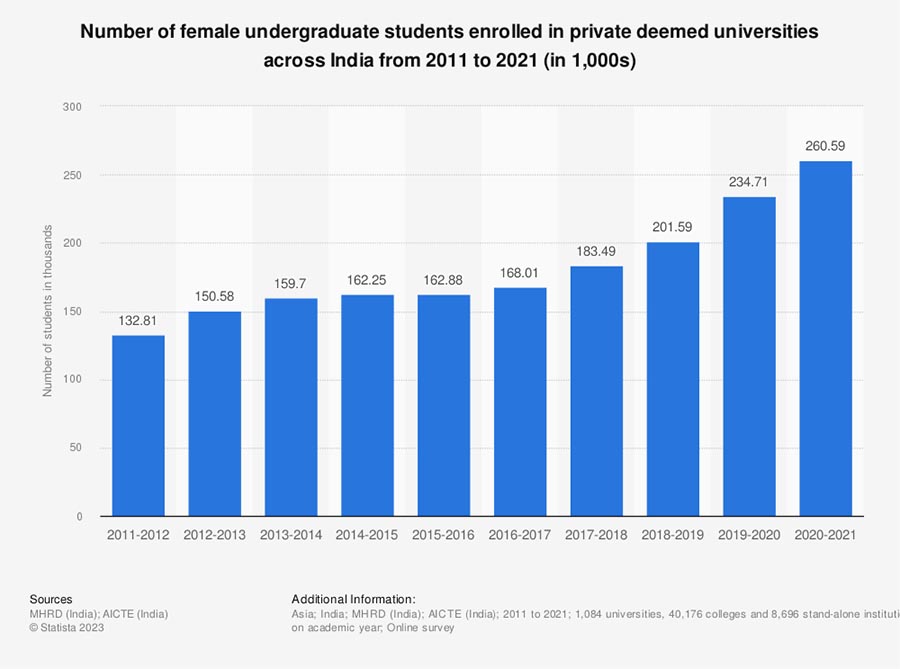
Female education is a crucial aspect of global development, and so far statistics show an upward trend. However, several challenges still need to be tackled to achieve gender equality in education, and more efforts are required to address the impact of the COVID-19 pandemic on education. Governments, NGOs, and international organisations need to continue investing in education programmes aimed at promoting gender equality and providing access to education for all. Only then can we achieve a more equitable and prosperous future for all.
Tags: Female Education, Women Empowerment