

CBSE Board Exams 2023: Dates, Last Minute Preparation Tips
The CBSE board exams are crucial for a student’s academic future as they heavily influence their career path. Achieving high scores in CBSE board exams is vital for pursuing further studies; hence, students strive to perform their best. However, securing good marks in these exams can be challenging.
With only a week left, some students may need help to adequately utilise the limited time frame to further excel in their preparations.
This article will guide you through some helpful tips and strategies to attain high scores in your 2023 CBSE board exams, but before that, let’s take a look at some important information regarding this year’s boards.
When Do The Exams Commence?
On December 29th, 2022, the Central Board of Secondary Education (CBSE) announced the date sheet for the upcoming board exams. They will commence on February 15th. Each exam will begin at 10:30 am.
To avoid further burdening on the students, the board has ensured a sufficient gap between each subject and has considered other competitive entrance exams while deciding the dates.
CBSE Board Exam Dates
| CBSE 10th Date Sheet | CBSE 12th Date Sheet |
| From: February 15th, 2023 – March 21st, 2023 | From: February 15th, 2023 – April 5th, 2023 |
| Timings | Timings |
| 10:30 a.m. to 1:30 p.m. | 10:30 a.m. to 1:30 p.m. |
10 Last-Minute Preparation Tips for Scoring Big in CBSE Board Exams
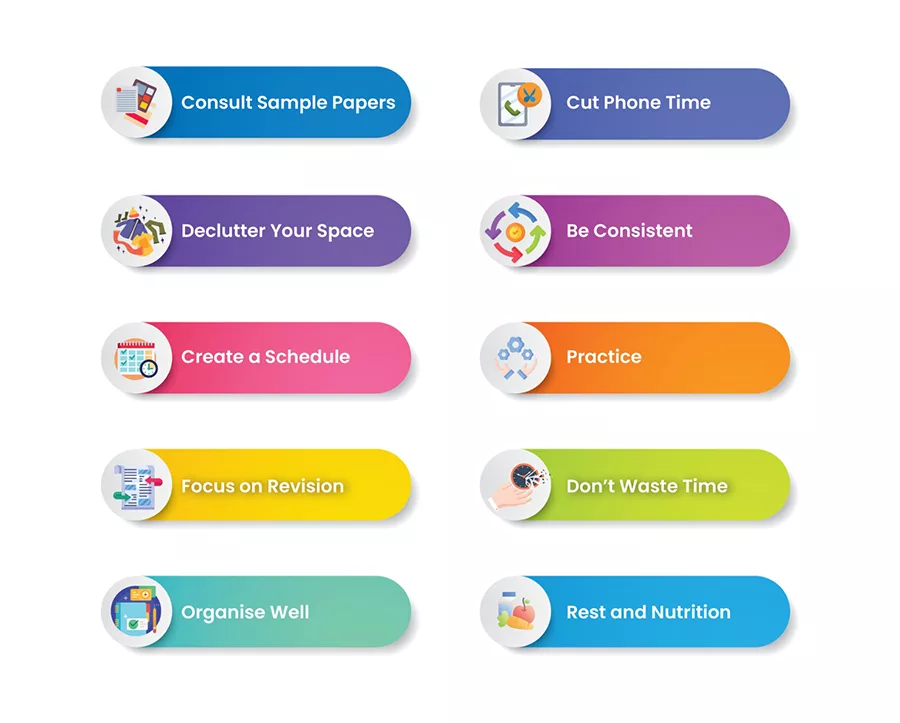
With only a few days left until the CBSE Board Exams 2023 begin on February 15, students should be working hard on ramping up their preparation and revision.
To ensure success on exam day, it’s crucial to follow a consistent study schedule and review key topics. However, there are additional steps students can take to bolster their preparation and maximise their scores. Here are some crucial tips for students to remember before the exam:
1. Consult Sample Papers
While preparing for the board exams, students need to review the last ten years’ papers and sample papers. Rather than trying to complete all the papers at once, it’s more effective to gather questions on the same topic and compile them together. This way, students can channelise their efforts better and develop a deeper understanding of what to expect on the exam day.
2. Declutter Your Space
When an exam is near, the first step is to remove all unnecessary items from your study area, such as your desk. Keep only NCERT textbooks, essential reference materials, and study notes around them. Focus on studying one book at a time instead of attempting to study multiple books simultaneously.
3. Create a Schedule
To ensure effective preparation, divide the chapters by the days left until the exam. This way, each day can be dedicated to one chapter. Additionally, using a timer when you are attempting to solve the compiled questions can help keep pace and make the most of your study time.
4. Focus on Revision
Students often make the mistake of not revising until the last day. It is important to understand that revision is crucial for excelling in exams. To perform well, read and revise the chapters, topics, and concepts multiple times, then write down key points in a notebook.
During the final stage of preparation, review these important notes.
5. Organise Well
When organising questions by topic, it is also helpful to categorise them by types, such as multiple-choice questions (MCQs), short answer questions, very short answer questions, and long answer questions. With consistent daily practice using this approach, success on exam day is more likely to be achieved.
6. Cut Phone Time
While studying, minimise distractions as much as possible. For example, instead of watching Netflix or using social media during free time, go for a walk or do some light exercises.
7. Be Consistent
Consistent practice is vital to mastering the art of writing effective answers in the examination. To improve, focus on refining the structure of your answers, making them concise and highlighting key points.
Additionally, ensure that your answer sheets are neat and organised, use clear diagrams for science answers, and utilise flow charts and diagrams whenever possible.
8. Practice
Repetition is the key for subjects like Mathematics, Physics, Chemistry, and Accountancy. Rather than just reading the formulas and equations, practising them for solving multiple problems helps to establish a smooth flow and increase accuracy.
9. Don’t Waste Time
When preparing, start with answering the easier sections of the question paper first. Then, take advantage of the flexibility to choose your sequence, as it will allow you to allocate more time for the more challenging sections. Remember to complete all answers within a section before moving on to the next one.
10. Rest & Nutrition
Lastly, stay relaxed and focused in the days leading up to the exams. Refrain from attempting to cram everything the day before; concentrate on the material you have already studied. Ensure that you get enough restful sleep and adequate nutrition. Take care of your health before and during exams.
Steps to Follow for Exam Day
The day of the exam can cause stress and anxiety for most students, who may be uncertain if they have done enough. To help you feel calm and confident, here’s a list of steps that can be taken to ensure that you are in the right state of mind.
- Arrive at the exam location at least 30 minutes prior to the scheduled start time.
- Avoid discussing the exam topic with friends, as it may confuse you.
- Use the first 15 minutes wisely to review the exam questions. Then, identify the easiest questions and start with them.
- Keep a steady pace when answering questions. Don’t get stuck on a single question. If unsure, move on and return to it later once you’ve completed the other answers.
- Concentrate on presenting your answers effectively. Use bullet points, include diagrams as necessary, and keep your answers concise.
Conclusion
CBSE board exams are an important stepping stone for college admissions and career opportunities, leading to understandable anxiety for students. The pressure of preparing for these exams, along with managing homework, test preparations, and extracurricular activities, can be very overwhelming. To perform well, it is essential to follow a consistent study schedule, time practice sessions, revise frequently, and take frequent breaks.
Tags: CBSE Board Exams 2023: Dates, CBSE Board Exams 2023: Tips, Last Minute Preparation Tips